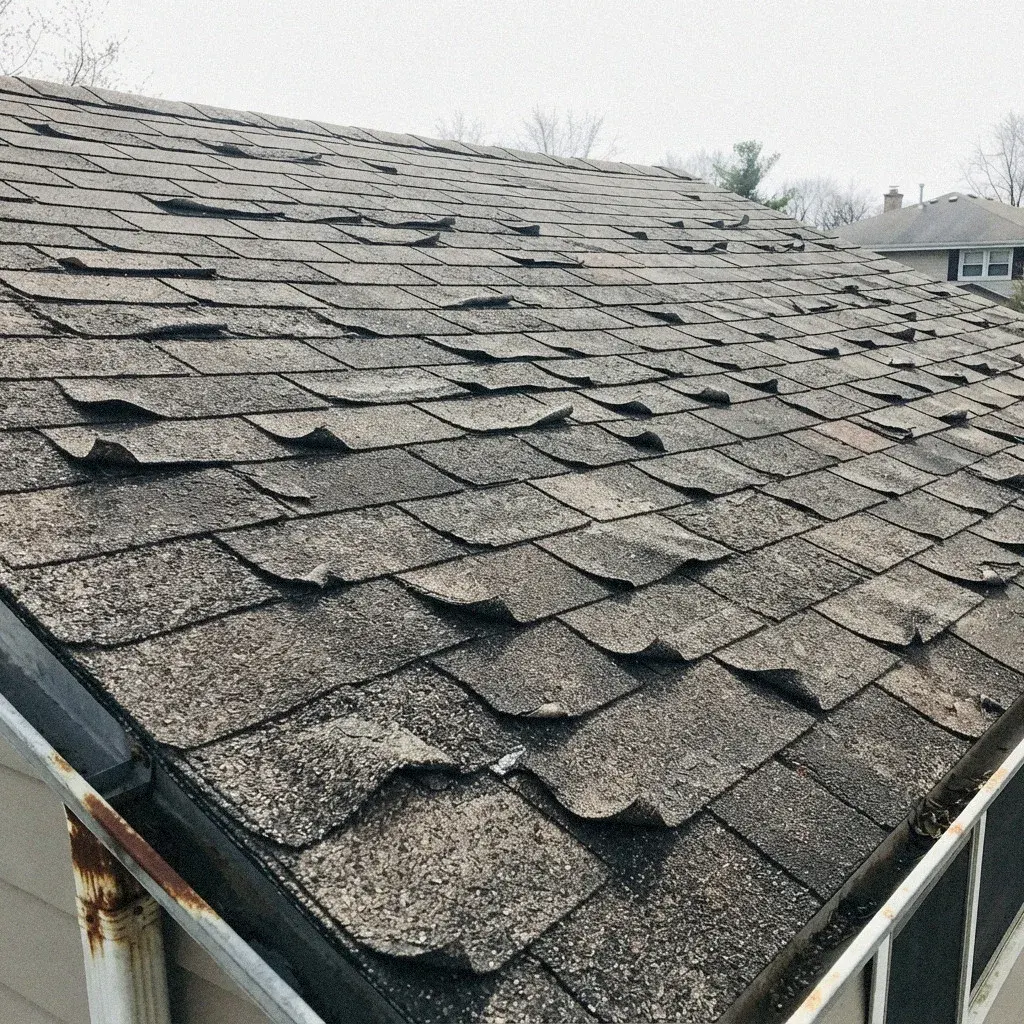
How Asphalt Shingles Age In Minneapolis
Minneapolis shingle roofs pass through recognizable stages between installation and the last winter they survive.
Rated life is a lab figure; achieved life is what a Minneapolis roof actually gets after winters of ice damming and summer hail. Most asphalt shingles here reach fifteen to twenty-five years, cut short by attic moisture and freeze-thaw stress on the mat.
Rated Life Versus What A Roof Actually Gets
A shingle marked for thirty years rarely gives a Minneapolis roof thirty years. That number comes from a lab running heat and UV lamps on a sample, not from a Longfellow attic through a real January. Rated life assumes steady conditions no house here actually has. A roof over a bungalow near Lake Nokomis ages against forty below wind chill one month and ninety-degree humidity the next, and that gap between the test bench and the actual weather is the whole reason two roofs stamped identically can look decades apart by year twenty.
Three-tab shingles are a single layer of fiberglass mat, light and flat, while architectural shingles bond two layers so the surface has thickness and shadow lines. That extra mass matters once a Minneapolis winter starts cycling roofs through freeze and thaw dozens of times a season. The thinner tab flexes more with each swing, so cracking and splitting tends to show up earlier on three-tab roofs than on the laminated kind, sometimes by a decade.
Fiberglass mat replaced organic mat decades ago in nearly every shingle sold, and it changes how a Minneapolis roof fails. Fiberglass resists moisture absorption better than the old organic base, so it doesn't swell and buckle the way older roofs over Prospect Park foursquares sometimes did. What fiberglass mat doesn't fix is UV degradation of the asphalt coating itself, which keeps breaking down the binder year over year regardless of mat type, eventually leaving the surface brittle under normal thermal movement.
Decade By Decade On A Minneapolis Roof
On a Minneapolis roof, granule loss often starts at the ridge and on south-facing slopes, the spots taking the most direct summer sun over a Fulton or Tangletown rooftop. Ridge shingles run hotter and get less runoff to rinse debris clear, so the asphalt underneath ages faster there than on a shaded north slope. Valleys and areas near flashing lose granules too, driven by water concentrating and moving across the surface repeatedly instead of shedding evenly like it does on an open field of shingle.
Minnesota's swing between summer heat and deep winter cold puts a shingle through a wide thermal range every single year, more extreme than most climates ask of a roof. Warm afternoons expand the mat slightly; a sub-zero January night contracts it hard. That repeated flexing works on the asphalt's plasticity, and it's a big part of why a shingle's achieved life on a Minneapolis roof can lag its rated life even when installation and ventilation were done right from the start.
- Years one through five, sealant strips bond fully under summer sun and the granule coat sits thick and even. A Minneapolis roof at this stage shows little beyond faint color settling; wind uplift resistance is at its strongest point of the shingle's whole service life.
- Years six through twelve: granule loss speeds up on slopes that face the afternoon sun, and sealant strips between courses start losing tack. Roofs over Kingfield and Tangletown bungalows with tight attic ventilation often show this wear first along the ridge.
- Years thirteen through eighteen, tab edges start curling upward as the asphalt mat loses flexibility from repeated winter freezing and summer heat. Nail pops surface where original framing has shifted seasonally, and shingles near ridge vents show the earliest lifting from wind.
- Years nineteen through twenty-four, curled tabs progress to outright cracking and splitting, particularly where foot traffic or ice buildup has flexed the mat repeatedly. Valleys and low slopes near chimneys hold moisture longest, so those sections typically age faster than open, well-drained fields of roof.
- Past year twenty-five, the shingle field commonly shows blistering where trapped moisture pushed through the mat during past summers, plus scattered bare spots where granule cover has worn through completely. Wind uplift resistance drops sharply once tabs have curled and cracked this far.
- There's no single date that marks a shingle roof's end of service life in Minneapolis. It arrives gradually, once granule loss, curled tabs, and failed nail holds combine so ice dams and spring rain start finding their way past the shingle surface instead of running off it.
Granule Loss And Sealant Strip Failure
Granule loss doesn't arrive as one steady wearing-down; it comes in phases tied to what's happening underneath. New shingles shed loose granules in the first year or two, just factory excess rinsing off in spring rain and settling in gutters near Lake Nokomis or Powderhorn Lake. Later shedding is different: the asphalt itself is breaking down from UV degradation and thermal cycling, and each granule lost after that stage takes real protection with it, not just cosmetic gloss.
The sealant strip is the narrow band of adhesive that bonds one shingle course to the row below, and it can fail on its own, separate from granule wear. Cold snaps common to a Minneapolis winter can prevent the strip from ever bonding fully if a roof goes on late in the season, since the strip needs sustained warmth to activate. Once that bond is weak, wind uplift can work a tab loose during a spring storm, and a single lifted tab often lets water track sideways underneath.
- A three-tab shingle carries a shorter rated life than an architectural shingle and shows curling sooner once its thinner mat starts flexing through Minneapolis freeze-thaw swings. Homes with older three-tab roofs near Camden or Folwell often reach the cracking stage well ahead of newer architectural installs nearby.
- Attic ventilation decides how much winter moisture builds against the underside of the shingle mat. In many pre-1940 Minneapolis bungalows, undersized soffit and ridge vents trap warm air that melts snow unevenly, feeding the ice dams that stress sealant strips at the eaves each season.
- Valleys, step flashing, and gutter capacity determine how long meltwater sits on a shingle course before it dries. Homes near Bde Maka Ska or Lake Nokomis with narrow side-yard valleys can hold moisture longer after a heavy spring thaw.
- Pitch and shade change recovery time after each freeze-thaw swing. Steep-pitched roofs common on Foursquare homes near Powderhorn Park shed water fast, while shallower sections shaded by mature trees in Linden Hills stay damp longer between cycles.
Cupping, Clawing, And Curling Explained
Cupping, clawing, and curling describe a progression, not three unrelated problems. Cupping is the tab edges lifting upward while the center stays flat, usually the first visible sign of a shingle losing flexibility. Clawing follows when the tab corners twist downward while the edges stay raised, a shape that shows up on plenty of older roofs around Webber-Camden and Camden after enough freeze-thaw cycles. Curling is the broader, more advanced version of the same deformation, and by that stage the shingle has lost most of its original flatness.
Cracking and splitting arrive later and mean the asphalt has lost its remaining flexibility, so instead of just curling under stress, the mat actually fractures. This tends to follow years of UV exposure combined with the freeze-thaw cycling a Minneapolis roof goes through every winter. A cracked shingle can no longer flex with the deck under thermal movement, and a nail pop nearby often accelerates the split, since the raised fastener head creates a stress point the shingle keeps flexing against.
| Years In | Condition | Driver |
|---|---|---|
| Years 1 to 5 | Tab corners lift, field stays flat | Sealant strip not yet fully bonded |
| Years 6 to 12 | Edges cup upward, granules thin at center | Fiberglass mat drying out under sun exposure |
| Years 13 to 20 | Tab twists and claws along its length | Years of freeze-thaw cycling and ice dam wetting |
| Years 20 and beyond | Blisters rise, then crack when walked on | Trapped moisture or gas under the mat |
| Any stage, storm-driven | Tabs crack and split along the edges | Hail impact or wind uplift on brittle shingles |
How To Spot A Roof That's Done
No shingle outperforms the work that put it on the roof. In Minneapolis, that means correct fastener count and placement, proper nailing height so the head doesn't cut into the mat, and courses run tight without gaps at the eaves near Bde Maka Ska or Lake Harriet. A rushed job shows up fast: sealant strips that never bonded, tabs that lift in the first hard wind off the Mississippi River, nail pops within a few winters. Rated life assumes a correct install; a sloppy one erases years before weather even gets involved.
Ventilation and drainage do as much to age a roof as the shingle itself. A poorly ventilated attic over a Bryn Mawr or Linden Hills bungalow traps heat in summer and moisture in winter, and that moisture is what feeds ice dams along the eaves once snow starts melting from below. Blistering can also follow trapped moisture, showing up as small raised bubbles where trapped vapor pushes up through the shingle surface. None of that shows from the driveway, which is why two identical shingles age so differently house to house.
When A Shingle Roof Is Truly Spent
There's rarely one moment that marks a roof's end; it's a slow pile-up of smaller signs. Granules keep collecting in the gutters season after season instead of tapering off. Tabs stay curled or clawed upward instead of lying flat once the sun warms them. Bald patches spread past a few shingles into whole slopes, often on the side of a Fulton or Kingfield bungalow that takes the most afternoon sun. Add a couple of active leaks after ice dams and the roof has told you what it needs.
Telling end of service life apart from a fixable problem takes an actual look at the roof, not just a glance up from a street near Lyndale Park. A shingle that cracks when bent slightly, granules that rub off in a handful, and tabs that stay lifted after a windy day are all signs the roof has used up its flexibility rather than just picked up cosmetic wear. A roof that's merely dirty or lightly weathered still bends without breaking, which is the practical test that separates the two.
Signs You're Near The End
- A Minneapolis roof rarely ages evenly across all four slopes. South and west faces take more direct sun and dry fastest after storms, while shaded north slopes near mature tree cover hold snow and moisture longer, aging that section of shingle noticeably faster.
- Freeze-thaw cycling is the dominant local stressor, not steady cold or steady heat. A shingle mat that expands under a sunny thirty-degree afternoon and contracts overnight below zero fatigues faster than one held at a constant temperature, which is why Minnesota winters age roofs unevenly.
- Some granule shedding right after installation is normal, as loose factory granules rinse off in the first rains. Granule loss showing up as bare patches a decade or more later means the asphalt mat underneath is losing its UV protection and wearing toward failure.
- Curling has two visible stages worth telling apart. Cupping shows as the tab edges lifting slightly upward first; later the whole tab twists and distorts further, a sign that moisture has been working into the mat for a longer stretch than cupping alone suggests.
- A popped nail is usually framing movement or seasonal shrink-swell, not a bad fastener. Once it backs out, the raised head lifts the shingle above it just enough for wind to catch an edge, and for meltwater to find a path down to the deck.
- A shingle roof winding down rarely fails everywhere at once. Leaks tend to start at valleys, chimney flashing, and the low eave line where ice dams collect each winter, well before the open, sun-exposed shingle field shows any sign of letting water through.
Frequently Asked Questions
How long do asphalt shingles last in Minneapolis?
Rated life comes from accelerated lab testing under controlled heat and moisture cycles. Achieved life is what actually happens on a Minneapolis roof, shaped by real winters near zero, roughly 51 inches of snow most years, and summer hail. A shingle rated for 25 years might reach 18 to 20 here if ventilation is poor or the install had shortcuts, or push past its rating if the attic breathes well and the work was done right.
Does a Minneapolis winter age shingles faster?
Not usually on its own. Minneapolis shingle failures mostly trace back to ice dams forcing water under tabs each winter, plus repeated freeze-thaw cycles that stress the fiberglass mat. Straight summer heat plays a smaller role than the freeze-thaw swing between a cold attic and a sun-warmed deck surface.
Why do shingles on my bungalow curl at the edges?
Rated life assumes proper nailing, balanced attic ventilation, and a roof that drains fast. Many Minneapolis bungalows near Linden Hills or Tangletown have shallower attic space than current code expects, so heat and moisture linger under the deck and shorten how long the shingle mat actually holds up.
Does granule loss mean the roof needs replacing now?
It matters, but it rarely stands alone. A roof reaching its final years typically shows granule thinning alongside curling tabs, cracked or split shingles in valleys, and popped nails near the ridge. Any one sign calls for a look; several together mean the roof deck itself is due for replacement.
Can poor attic ventilation shorten shingle life?
Plenty of Minneapolis foursquares and Colonial Revival homes built before 1940 still carry an asphalt roof laid over the original deck, sometimes a second layer added decades later. Older neighborhoods like Prospect Park and Seward mix these aging original roofs with newer tear-off replacements block by block.
Want An Honest Read On Your Roof's Age?
Curious what stage your Minneapolis roof has reached? The licensed pros we connect you with can inspect the slopes and tell you plainly.
Call (612) 493-0152