How Minneapolis Roof Inspections Actually Work
What a Minneapolis inspector checks, how it's documented, and what the findings mean for repair or replacement.
A Minneapolis roof inspection starts in the attic, checking for staining, frost, and damp insulation, then works the roof itself slope by slope: shingles, valleys, flashing, penetrations, and gutters. Findings come back as dated photos with a condition rating for each area, which tells you what to fix now and what to plan for.
Four Situations, Four Inspections
Not every roof inspection is the same errand. Four situations bring one about, and each one is asking a different question. A maintenance check asks what needs attention before the next winter. A buyer's inspection asks how much roof is left and what it will cost. A storm inspection asks which of this damage is attributable to one event, because that is the only part an insurer will pay for. A warranty inspection asks whether a failure traces to the material or the installation. The same roof, looked at four ways, produces four different reports.
All four start the same way, though, and it is not on the roof. It is in the attic. Standing under the deck with a flashlight shows staining, frost, daylight at a penetration, and damp insulation, and none of that is visible from above. On an older Minneapolis house the attic is usually where the story is, because ice dam water travels along the underside of the sheathing before it ever marks a ceiling. Only after that does the inspector go up and work the slopes, the valleys, the flashing, and the penetrations in order.
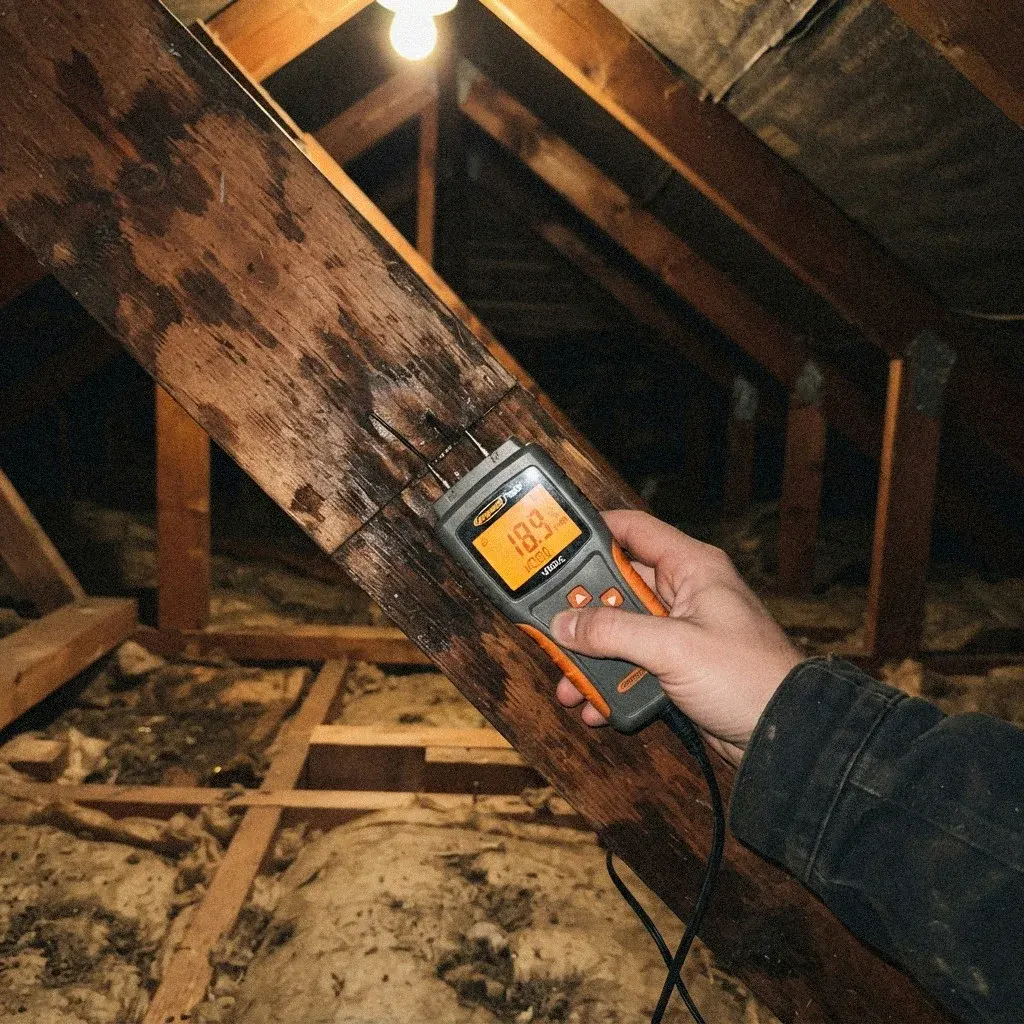
A moisture meter comes out when the visual pass raises a question. It reads dampness inside the decking without cutting into it, which matters after an ice dam has pushed water back under shingles near the eaves. An infrared scan can show a wet section by its temperature difference from dry decking around it. A core sample or test squares get pulled rarely, usually for a warranty dispute where someone needs to see the layers, not just guess at them.
What Gets Checked, Area By Area
Exterior scope on a Minneapolis roof starts with the shingle field itself: cracked, curling, or missing shingles, granule loss in the gutters, and moss or lichen on the shaded north slope common near Lake Harriet and Lake of the Isles. A penetration survey covers every pipe boot, vent, and skylight curb, since these small parts fail years before the shingle field around them does, especially after repeated freeze-thaw cycling.
A flashing check covers every seam where the roof meets something else: chimney, dormer, skylight, or the wall of an addition common on older Minneapolis foursquares. Valleys get checked for granule buildup and debris that can dam meltwater during a freeze-thaw cycle. A penetration survey looks at every pipe boot and vent flashing on the roof, since a failed boot seal is one of the more common sources of a slow leak nobody notices until winter.
- The visual inspection starts on the roof field itself, walking or viewing each slope for lifted or missing shingles, granule loss, and cracked ridge caps, the kind of wear that shows up first on older bungalow roofs in Seward or Powderhorn Park.
- Flashing gets its own pass: the metal at every wall junction, chimney, valley, and skylight curb, since these transitions leak far more often than open shingle field does.
- Gutters and downspouts get checked for ice, sag, and whether water clears the foundation, which matters on a home with a full basement dug to Minnesota's frost-depth footing rule, since standing water near the wall works against that foundation over time.
- The attic is where an inspection either earns its fee or does not. From below the deck, frost, dark staining, damp insulation, and daylight at a penetration all show up long before anything marks a ceiling in the room underneath.
- Penetrations get counted and checked one at a time: plumbing stacks, furnace and bath vents, skylights, and any old opening someone patched over. A brittle pipe boot is among the most common single causes of a leak on a Minneapolis roof.
- The photo report places a dated image at each finding, tied to a spot on the roof plane, so a homeowner in Whittier or Lowry Hill East can see exactly where a soft spot or a gap in flashing sits.
Turning a Walk-Through Into a Record
Interior scope means walking rooms under the roofline, not stopping at the attic hatch. A stain spreading across a bedroom ceiling, paint bubbling near a chimney chase, or trim that's gone soft near an exterior wall all point back to a roof problem that's been running longer than anyone realized. In a Linden Hills or Longfellow home built before 1940, these signs often show up on a plaster ceiling well before anyone notices a shingle out of place outside.
Attic inspection is where an ice dam usually tells its real story. The inspector looks for rust on nail heads, dark staining on the underside of decking, and insulation that's matted down from past moisture. A soft spot near a valley or chimney chase often shows up here first, before it ever punches through drywall below. Ventilation gets checked too, since poor attic airflow is part of why ice dams form on older Minneapolis housing stock in the first place.
- A maintenance inspection is a routine check, often done once a year, meant to catch a lifted shingle or a clogged gutter before the next Minneapolis winter turns a small gap into an ice dam leak.
- A real estate inspection is timed to a transaction, so it answers how many years of roof are left and what a buyer should expect to spend, with the report going into the negotiation rather than a maintenance file.
- A storm inspection has a narrower job: separating what one hail or wind event did from what age had already done, because an insurer pays for the first and excludes the second. Dates and photos carry more weight here than anywhere else.
- A warranty inspection looks at whether a leak or shingle failure traces back to defective material or a bad install, which matters because most manufacturer coverage requires proof the roof was maintained and installed to spec in the first place.
Why a Report Isn't a Bid
Gutter and drainage scope gets its own look because a sound roof surface can still send water somewhere it shouldn't go. The inspector checks for sagging runs, loose hangers, and downspouts that dump water against a foundation instead of carrying it away. Given the clay-heavy soil under most Minneapolis lots, water pooling near a foundation wall is worth flagging on its own, separate from anything happening up on the shingles.
Debris in Minneapolis gutters tracks the tree canopy overhead more than anything else. Neighborhoods with heavy boulevard tree cover, like stretches near Lake Harriet or Minnehaha Creek, see gutters pack with leaves and seed pods every fall, right before the first hard freeze locks whatever's in there in place. A gutter clogged going into winter is a common contributor to ice dams, since it gives melting snow nowhere to go but back under the shingles.
| Type | Trigger | Usual Concerns |
|---|---|---|
| Maintenance inspection | Routine, no damage assumed | Timed to age and season |
| Post-storm inspection | Follows hail or high wind | Soon after the event |
| Documented by | Inspector, photo report attached | Contractor writing the bid |
| Attic access | Standard part of the visit | Only if repair needs it |
| Best used for | Warranty coverage review or renewal | Improper attic ventilation, missed flashing details |
What the Condition Rating Tells You
A condition rating is a shorthand, and knowing what it is shorthand for keeps it useful. It is a judgment about remaining service life, not about whether the roof leaks today. A slope rated fair can be perfectly dry and still be a few years from a reroof, and a slope rated good can have one torn boot letting water into a bedroom. Read the rating and the findings together, because the rating tells you when to plan and the findings tell you what to do this month.
Reading a report means looking past the photos to the condition rating attached to each finding. Some inspectors separate the field of the roof from flashing and penetrations, since those fail on different timelines. A rating of fair on a valley doesn't carry the same urgency as a rating of poor on a chimney flashing check, and knowing which is which keeps a homeowner from either overreacting or ignoring something real.
Turning Findings Into Decisions
A report is only worth what gets decided from it, so the useful next step is sorting the findings into three piles rather than reading them as one list. Things that are letting water in now go first, whatever they cost. Things that will let water in by the next thaw go second, and in Minneapolis that pile fills up in the fall. Things that are simply wear, granule loss on a south slope, a bit of curl at a rake edge, go on a watch list with a date to look again. Most homeowners lose money by treating the third pile as urgent and the second as optional.
This split matters most when more than one contractor is involved. An inspection report written independent of any bid gives a Minneapolis homeowner something neutral to compare estimates against, rather than trusting whichever roofer showed up first. It also gives an insurer or a buyer's agent a document that isn't tied to whoever stands to get paid for the repair, which carries more weight in a claim or a sale near neighborhoods like Seward or Prospect Park.
Inspection Basics At A Glance
- Asphalt shingle covers most Minneapolis roofs, on bungalows in Fulton and foursquares in Tangletown alike, with a smaller share of standing seam and low-slope membrane on additions and flat-roofed sections near the Mississippi River.
- Ice dam evidence is checked from inside as well as out, since backed-up meltwater stains the underside of the sheathing near the eaves before it ever shows on a shingle.
- Hail from summer thunderstorms bruises shingle mat without always breaking it, so an inspector checks soft spots with hand pressure and a moisture meter rather than judging damage by sight alone from the ground.
- A written report with dated photographs is the deliverable worth asking for. A verbal summary from a ladder gives a homeowner nothing to compare bids against or hand to an insurer later.
- A penetration survey checks every place something pierces the roof deck near Kingfield and Longfellow homes: plumbing stacks, furnace vents, skylights, and chimney flashing, since these spots fail long before open shingle field does.
- Late summer through fall is the practical season for an inspection here, since findings can still be acted on before snow sits on the roof and freeze-thaw cycling starts working on whatever was left open.
Frequently Asked Questions
What does a roof inspector actually look at?
The attic first, then the roof. Under the deck they are looking for staining, frost, damp insulation, and daylight at any penetration, because that is where an ice dam leak shows up long before a ceiling does. On the roof it goes in order: the field of each slope for lifted, cracked, or missing shingles and granule loss; the valleys; the flashing at every wall, chimney, and skylight; every pipe boot and vent; then the ridge, the drip edge, and the gutters. Penetrations and flashing get the most attention, because that is where roofs actually leak.
How is a pre-purchase inspection different from a regular one?
A visual inspection covers roof slopes for lifted or missing shingles, flashing points at chimneys and valleys, and gutters, plus a look at the attic underside for staining. On a Minneapolis bungalow or foursquare with a steep pitched roof, plan on thirty to sixty minutes depending on stories and attic access.
Do inspectors use tools, or just look?
Mostly they look, but a few tools decide the questions eyes cannot. A moisture meter reads dampness inside the decking without cutting it open, which matters after an ice dam has pushed water back under the shingles. An infrared camera finds the cold, wet patches in an attic that a flashlight misses. Hand pressure on a slope tells whether hail bruised the mat under an intact surface. A chalk line and a camera do the documenting. What none of them replace is getting into the attic, which is still the single most informative part of the job.
What's a core sample and when is one needed?
A core sample is a small plug cut down through the roof so the layers underneath can be seen and measured directly: how many roofing layers there are, what the insulation is, and whether the deck is wet. It is destructive, so it gets patched immediately, and it is not part of a normal residential inspection. It comes up on low-slope and flat sections, the kind of addition or garage tie-in common on older Minneapolis houses, where a membrane hides everything below it and a moisture meter reading is ambiguous.
Does a report tell me the cost of repairs?
Usually not, and there is a reason to want it that way. An inspection report describes condition and names findings; an estimate prices work. When the same company does both, the person deciding what is wrong is also the person selling the fix, and that is a hard position to read neutrally. A report written on its own gives you something to hand to two or three roofers and compare their numbers against. Some inspectors do include rough ranges, but treat those as scale rather than as a quote.
Ready to get a roof looked at properly?
Get a written inspection report, with dated photos and a clear condition rating, from a licensed pro matched to your Minneapolis address.
Call (612) 493-0152