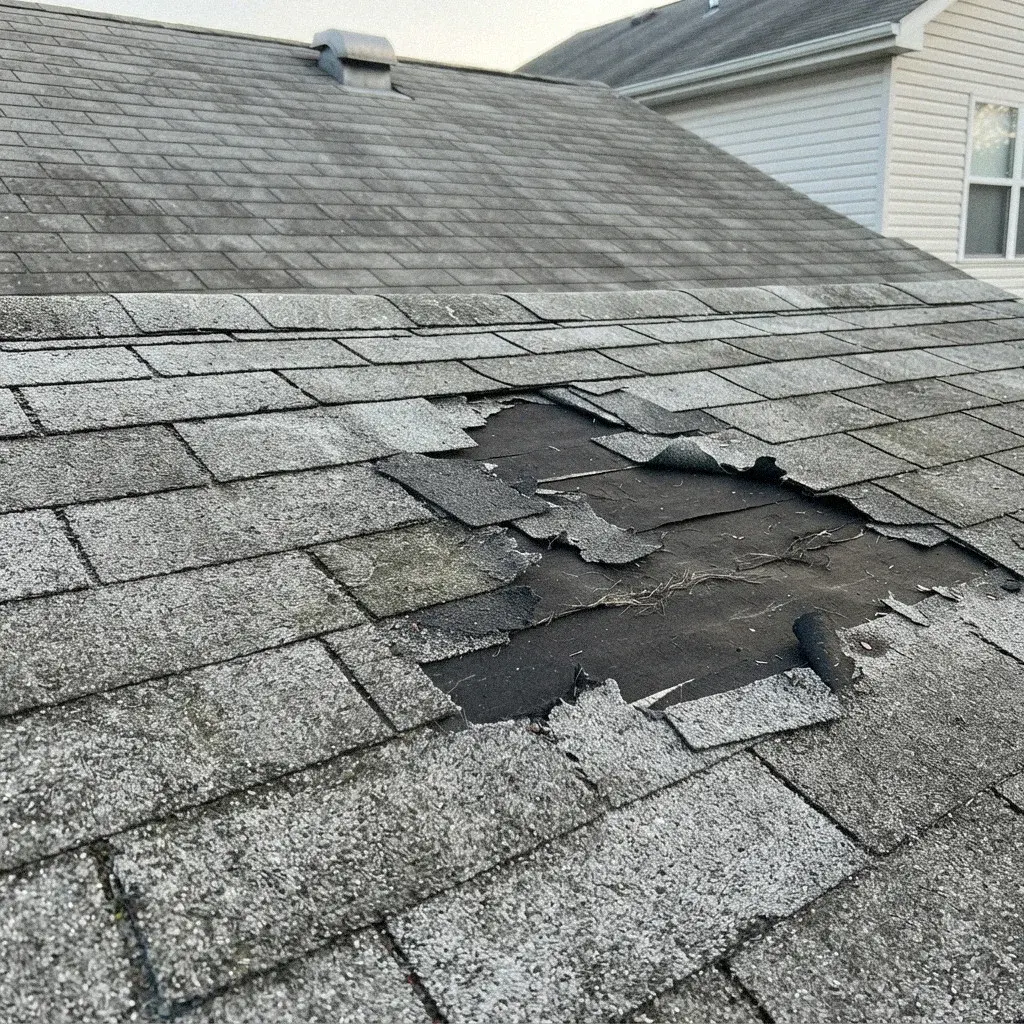
Getting a Hailstorm Claim Paid in Minneapolis
How the claim actually moves from storm date to settlement check on a Minneapolis roof.
A hail claim turns on documenting the storm date, getting a written scope rather than a price, and knowing your payout type. Replacement cost and actual cash value differ mainly by depreciation.
Document the Storm and the Damage
Hail hits a Minneapolis roof hard enough to matter every few years, usually with a spring or summer thunderstorm rolling through neighborhoods like Kingfield, Fulton, or Longfellow. The damage is real but rarely dramatic to look at. A homeowner who steps outside afterward often sees dented gutters and stripped leaves and assumes the roof came through fine, then finds out months later, when a leak shows up, that the shingles took a beating the eye missed entirely.
The claim itself moves in a set order, and skipping a step usually costs money later. Write down the date of the storm before anything else. Insurance carriers anchor a claim to a specific event, and a vague memory of "sometime in June" is weaker than a date tied to a National Weather Service report or a neighbor's timestamped photo from Tangletown or Seward.
Next comes getting someone qualified on the roof, and that person's job is to document, not to sell. A roof in Prospect Park or Cedar-Isles-Dean that took a hailstorm needs an inspection focused on writing down what's there, mat exposure, granule loss, soft spots, not quoting a replacement before the adjuster has even seen it.
Getting a Scope, Not a Price
Bruised shingles are the part homeowners in places like Linden Hills or Diamond Lake most often misunderstand. Hail can crack the asphalt mat underneath without tearing the surface, so from the ground, or even from a ladder, the roof can look untouched. The granules stay put, the shingle stays flat, and the damage only shows up as a soft, spongy spot when someone presses on it by hand.
That bruising matters because it shortens the shingle's remaining life even though it hasn't failed yet. A bruised mat lets water in eventually, sometimes a season or two later, once freeze-thaw cycles or the next Minneapolis winter work on the crack. This is why a written scope from the roof inspection matters more than a photo taken from the driveway in Whittier or Lyn-Lake.
- Start by writing down the date of the storm and taking photos of visible damage the same day if it's safe to do so. Minneapolis and Hennepin County both see hail with spring and summer thunderstorms, and carriers often need that date to match the claim to a specific weather event.
- Get a roofer on the roof who documents damage with a written scope rather than handing over a repair price first. A scope lists each affected area and component, which gives an adjuster something concrete to compare against instead of a single lump estimate.
- Hail bruises shingles by breaking the mat fibers underneath the granule surface, and that kind of damage often looks like nothing from a Minneapolis street or driveway. A roof can carry real hail bruising with no missing granules or visible cracks visible from the ground.
- The adjuster visit usually follows the homeowner's initial claim filing, and the adjuster inspects the roof to confirm damage and prepare their own scope of loss. Having a roofer's scope already in hand before this visit gives the homeowner a second, independent record to compare against.
- A scope of loss lists every component the insurer agrees needs repair or replacement, with a cost tied to each line. This document, not a verbal estimate, is what actually drives the payout, so reading it carefully before signing matters more than any other single step.
- Some policies carry a separate roof endorsement with its own depreciation schedule or payout cap, distinct from the rest of the dwelling coverage. A Minneapolis homeowner won't know if this applies to them without reading their own declarations page, since it isn't standard on every policy.
What the Adjuster's Scope Covers
The adjuster visit is where the claim either lines up with the roofer's findings or doesn't. The adjuster represents the insurance company, not the homeowner, and their job is to inspect the roof and write their own assessment of the damage and its cause. A homeowner in Powderhorn Park or Bryn Mawr benefits from being present for that visit, not to argue, but to point out anything the adjuster's walk-through might miss.
Actual cash value pays the depreciated worth of the old roof, while replacement cost pays what a new one costs to install. On a Longfellow or Kingfield bungalow with a roof already twenty years in, that gap can run into thousands of dollars withheld until the work is finished and proof submitted. Some policies release the difference only after a contractor's final invoice is on file, so ask which method applies before signing anything.
- Replacement cost value pays what it costs to install a comparable new roof today, without subtracting for the roof's age or wear. It's the more complete payout of the two settlement types, but not every policy pays it in full upfront.
- Actual cash value pays replacement cost minus depreciation, calculated from the roof's age and remaining expected life. On a roof already fifteen or twenty years old in a Minneapolis neighborhood like Longfellow or Kingfield, that depreciation deduction can be substantial.
- Some actual cash value policies are recoverable, meaning the depreciated amount gets paid back once the homeowner completes the repair and submits proof. Others are non-recoverable, meaning that depreciated portion is simply gone, so checking which type applies matters before assuming the full payout is coming.
- A denial usually comes down to the carrier deciding the damage reflects age and wear rather than a specific hail event. This is why the date documented at the start and a roofer's written scope matter: they tie the damage to a storm instead of leaving it open to an age argument.
Replacement Cost Versus Actual Cash Value
Replacement cost and actual cash value are two different numbers on the same claim, and the difference is often the largest sum in dispute. Replacement cost value pays what it actually costs to put a new roof on a home in Fulton or Kenwood today. Actual cash value takes that same figure and subtracts depreciation for the roof's age, which on an older shingle roof can be a substantial cut.
Many policies pay actual cash value first and release the depreciated amount, called recoverable depreciation, only after the roof is actually replaced and the homeowner submits proof. A roof on a foursquare in Tangletown that's fifteen or twenty years old can see a meaningful gap between the initial check and the final payout, so understanding which value applies to a given policy matters before signing a contract.
| Step | Who Handles It | What Changes |
|---|---|---|
| Payout basis | ACV pays depreciated value | RCV pays full replacement cost |
| Roof age factored in | ACV subtracts for age | RCV ignores age at payout |
| Money up front | ACV check comes first | RCV releases funds after repair |
| Older Minneapolis roof impact | ACV gap grows with age | RCV closes that gap |
| Recoverable depreciation | ACV withholds it initially | RCV releases it on completion |
Sudden Hail Damage Versus Ordinary Age
Every hail claim eventually runs into the question of sudden damage versus ordinary age, because that's the line insurance policies draw around what they'll pay for. Hail that cracks a mat or knocks granules loose in one afternoon is sudden and accidental, the kind of event policies are written to cover. A shingle roof in Kingfield or East Isles that's simply worn out from twenty Minnesota winters is a maintenance and age issue, not a covered loss.
Denials most often turn on this exact distinction, with the carrier arguing that wear the homeowner attributes to a specific storm was already there from age and weathering. This is where a documented, dated inspection carries real weight, since it ties the damage to a specific event rather than leaving the cause open to interpretation months after the fact.
Replacement Cost vs. Actual Cash Value
Some homeowner policies in the Minneapolis area carry a separate roof endorsement, sometimes called a roof surfaces schedule or a cosmetic damage exclusion, that changes how a hail claim on the roof specifically gets paid compared to the rest of the house. A roof endorsement can cap payout at actual cash value regardless of the home's overall coverage, or exclude damage that's purely cosmetic, like granule loss without a functional problem.
None of these deadlines, exclusions, or endorsement terms come from a roofer, they come from the policy itself, and the wording varies by carrier and by the specific policy purchased. A homeowner in Longfellow or Como with questions about what their policy actually covers should read their own declarations page and endorsements rather than relying on a verbal summary, since the exact language is what an adjuster and, if it comes to it, an appraiser will be working from.
Claim Terms Worth Knowing
- Sudden hail damage is tied to a specific dated storm; age-related wear has no single event behind it and develops gradually across years of Minneapolis winters and summer sun.
- A scope of loss is the itemized list of damaged components and costs that actually determines the payout, separate from any repair price a roofer might quote upfront.
- Bruised shingles from hail can look completely normal from a driveway or the street; the damage is often only visible on close inspection of the shingle mat itself.
- Replacement cost value pays for a comparable new roof without deducting for age; actual cash value subtracts depreciation first, and the gap grows on an older roof.
- Insurers weigh whether hail bruising happened in one recorded storm against whether shingles simply reached the end of their service life. That distinction, not the dollar total, is usually where a Minneapolis claim gets approved or turned down outright.
- Some Minneapolis policies list roof coverage on its own schedule with different payout terms than the rest of the house. Whether that applies, and under what wording, sits in the declarations page the homeowner holds, not in anything a contractor can quote from memory.
Frequently Asked Questions
Will a roofer give me a free estimate?
No. A roof inspection after a Minneapolis hailstorm is meant to document what's on the roof, not to hand over an estimate before an adjuster has weighed in. A written scope that lists specific damage, by location and type, holds up better against an insurance adjuster's assessment than a same-day price quote, which reads more like a sales pitch than evidence tied to the storm.
What's the difference between actual cash value and replacement cost?
A written itemized breakdown covers every roof component the carrier will pay for, quantities included, so a homeowner can compare it against the check received. Minneapolis contractors preparing estimates for insurance work should build to that document, not to a flat number, because a low unitemized figure often signals corners cut on materials or steps like drip edge and starter strip.
Can hail damage be denied as just old age?
Replacement cost pays what a new roof costs today. The other basis withholds an amount tied to the roof's age and wear, then releases it once the work is finished and proof is submitted. On a Minneapolis bungalow with an original roof from decades back, that withheld portion can be large enough to change whether the repair happens at all.
What is a roof endorsement on my policy?
Hail damage is sudden and dated to a specific storm; a carrier can usually confirm it against Hennepin County weather records. Age-related wear develops slowly from years of Minnesota winters and UV exposure, with no single event behind it. Adjusters look for granule loss patterns and bruising tied to a hail event, not just general wear, before approving a claim.
How long after Minneapolis hail can I still file?
Deadlines for filing, appealing, or supplementing a claim come from the policy itself, not from any roofer. Wording on covered perils, depreciation schedules, and roof endorsements also varies by carrier and by policy year. A Minneapolis homeowner should read their own declarations page and policy contract directly rather than relying on secondhand summaries.
Not sure where your claim stands?
Get a written scope from the licensed pros we connect you with before your adjuster visit, not after a denial letter arrives.
Call (612) 493-0152