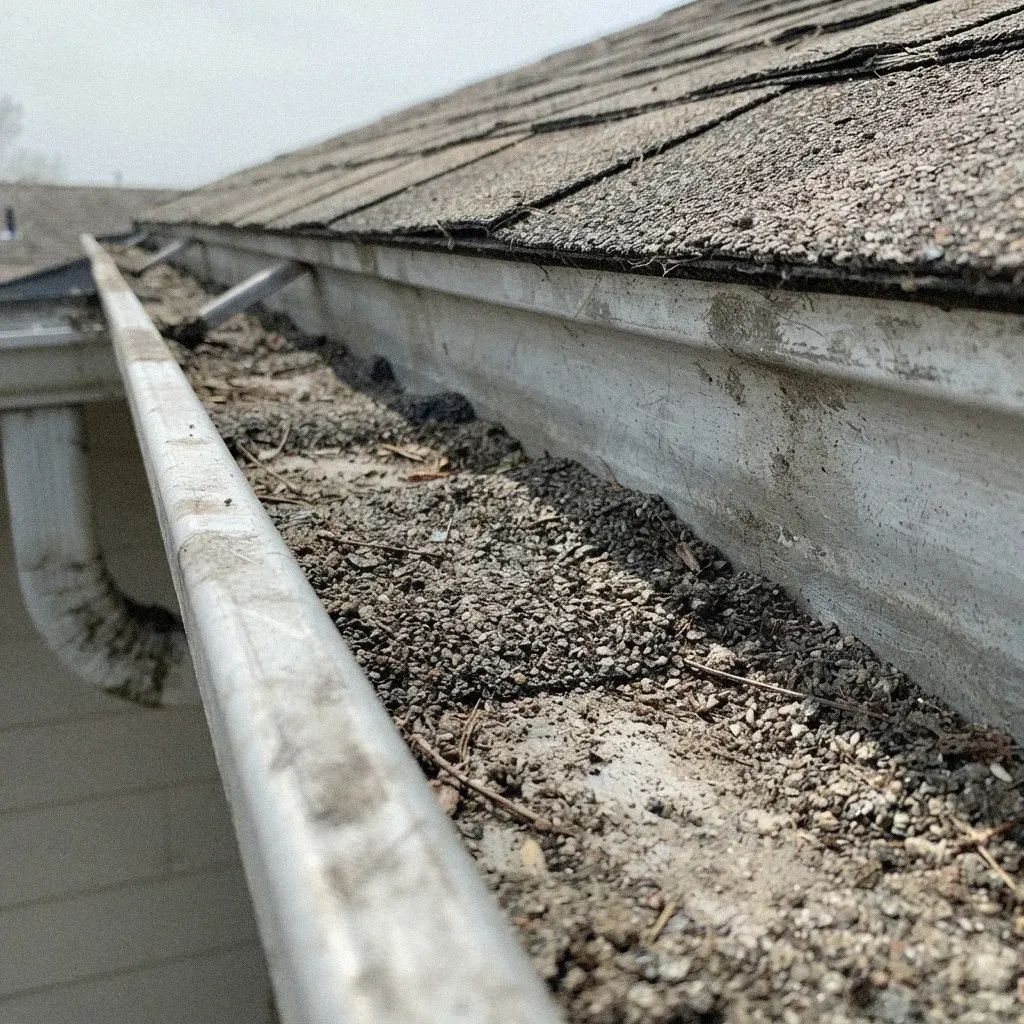
Any composition shingle roof in Minneapolis, from a Kingfield bungalow to a Longfellow foursquare, sheds ceramic granules for its entire life. Manufacturers set them into the top coat so the asphalt underneath doesn't cook under UV exposure. Losing some is normal aging, not failure. What matters is telling ordinary shedding apart from a rate that means the shingle exposure is thinning faster than it should, and gutters are where that story first shows up.
New Roof Shedding Explained
A roof installed in the last year or two often sheds loose granules that never fully bonded during manufacturing or the reroof itself. Freeze-thaw cycles through a Minneapolis winter and hard spring rain both help that loose material work free faster than a mild climate would. This break-in shedding shows up heaviest after the first few storms and tapers off steadily. It doesn't reappear at the same volume cleaning after cleaning once the roof settles in.
When Loss Keeps Climbing
Progressive loss looks different from break-in shedding. It shows up on a roof well past that early window, often a decade or more old, and instead of tapering off, the volume in the gutter stays steady or grows with each cleaning. That pattern points to the asphalt mat itself losing its grip on the surfacing, which is a wear signal rather than leftover manufacturing debris working its way out.
Reading Bald And Shiny Spots
New shingles installed near Tangletown or Fulton often shed loose granules for the first few hard rains, since manufacturing leaves extra material sitting on the surface until weather works it free. That's the break-in period, and it tapers off fast. A bald spot is different: a patch on the shingle itself where the mat shows through, usually on one section rather than scattered evenly, and it doesn't stop once the roof settles in.
Why Slope Sheds Differently
Slope matters more than most homeowners expect. A south-facing roof over a Powderhorn Park or Seward home takes the harder sun through summer and tends to wear faster than a shaded north slope. Snow load and ice sitting on a roof through a Minnesota winter adds its own stress on top of that sun exposure. So two slopes on the same house, built the same year, can shed granules at noticeably different rates without either one being a problem.
Judging The Actual Amount
One cleaning tells you almost nothing. A homeowner near Diamond Lake who clears the gutters and finds a light scattering of granules has nothing to worry about. The number that matters is the trend across seasons: roughly the same small amount every time versus a pile that keeps growing, or bare patches showing through the shingle that weren't there the year before. Track it over a couple cleanings before drawing any conclusion.
Blisters And Sudden Releases
Blisters are a different mechanism from ordinary wear, and they release granules all at once rather than gradually. A blister is a small pocket of trapped moisture or gas under the surface of the shingle that expands when the roof heats up, and when it finally pops it takes a coin-sized patch of granules with it. What you get in the gutter afterward is a sudden handful rather than a steady trickle, sometimes on a roof that is otherwise in good shape. A few scattered blisters are not an emergency. A slope covered in them means the shingle batch itself has a problem, and that is a manufacturer conversation rather than a repair.
What The Splash Block Catches
A downspout splash block is worth a quick look because runoff funnels straight through it on its way off the roof. If a homeowner near Bryn Mawr or Cedar-Isles-Dean notices a heavier buildup there than in the gutter trough itself, it usually just means that downspout drains a larger section of roof. It's a convenient sampling point, not a separate warning sign, and it's easiest to check right after a hard summer thunderstorm off the Chain of Lakes.
Uneven Wear Isn't A Defect
Minneapolis winters add a wrinkle that sunnier climates don't have. Freeze-thaw cycles through a long cold season stress the asphalt mat repeatedly, and a roof that also deals with ice damming along the eaves can lose granules faster right at that edge than higher up the slope. That's worth separating from sun-driven wear on a south face, since the cause and the fix aren't the same even though both end up as granules in the gutter.
Roofs Where This Doesn't Apply
This entire read only works for composition shingle roofs. Some older Minneapolis housing stock near Kenwood or Lowry Hill still carries slate or standing-seam metal roofing instead of asphalt, and neither one sheds granules because neither one has any. Finding grit in a gutter under one of those roofs usually means something else entirely, like roof cement grit, mortar debris, or leaf litter, not shingle surfacing wearing away.
Deciding If It Needs A Look
A gutter check is a starting point, not a verdict. It tells you volume and timing, but it doesn't show wear pattern across the whole roof or confirm whether shingle exposure has actually thinned in a given spot. Getting a full answer means looking at the shingles directly, comparing slopes side by side, and factoring in the roof's age, something a homeowner near Uptown or the Mill District can do from the ground with binoculars before calling anyone up on a ladder.
Watching It Over The Seasons
The habit that actually helps is watching the same splash blocks and gutter sections every season instead of reacting to a single cleaning. Note roughly how much shows up each time, whether it's spread evenly or concentrated at one downspout, and whether any slope near St. Anthony West or Prospect Park is pulling ahead of the others. That pattern, tracked over a year or two, tells a homeowner far more than any one cleanup ever could.
Dealing with this in your home?
Minneapolis roofs carry the weight of two seasons pulling in opposite directions. Bungalows near Kingfield and Longfellow trap heat in poorly vented attics, melting snow that refreezes at the eaves into ice dams. Come summer, hail off a Hennepin County thunderstorm can strip granules city-wide, no matter the neighborhood.